

Stock control
Backbar or retail: why salons should track them separately
The short answer
Backbar stock is what your team uses on clients during services, such as colour, developer and backwash shampoo. Retail stock is what clients buy to take home. Track them separately because they behave differently: backbar is part of the cost of every service, retail is stock you sell, and they run out at different speeds.
What is backbar stock in a salon?
Backbar stock is every professional product your team uses on clients: colour, lightener, developer and toners at the colour bar, and the shampoos, conditioners and treatments at the basins. Some salon software calls it professional stock. It is not sold to clients; you get its cost back through the price of your services.
- At the colour bar: permanent and semi-permanent colour, lightener, developer, toners and bond treatments.
- At the basins: shampoo, conditioner, masks and treatments, often in large salon sizes.
- At the station: the styling products used to finish a client.
- Sundries: foils, gloves and cotton wool. Not glamorous, but a service stops without them.
Salon software that handles stock can keep the two apart. Phorest, for example, says it tracks retail and professional stock separately.
What is the difference between backbar and retail stock?
The difference is who uses the product and how you are paid for it. Backbar is used by your team on clients, a little at a time, and paid for through the service price. Retail is bought by clients to use at home, leaves the shelf whole and is paid for at the till.
| Question | Backbar | Retail |
|---|---|---|
| Who uses it | Your team, on clients | Clients, at home |
| How it leaves the shelf | Used in services, a little at a time | Sold whole, at the till |
| Sizes | Often large salon sizes: litre bottles, tubes, tubs | Home sizes |
| How you are paid back | Through the price of each service | Through the sale |
| What goes wrong | Running out mid-service, waste, over-mixing | Slow sellers, cash tied up, products past their best |
| When to record it | When a product is opened or used | When a product is sold |
| How to count it | Unopened units, plus one rule for opened ones | Every sealed product |
Why should salons track backbar and retail separately?
Because mixing them hides problems in both. A retail bottle taken to the backwash looks like a missing sale, backbar costs disappear into one general stock figure, and a single reorder rhythm ends up wrong for both. Separate records show your real service costs and your real retail sales.
- Your service costs become visible. You can see what backbar each kind of service uses, and price it properly.
- Retail losses show up. When the two are mixed, a bottle that went to the basin, out of the door or to a friend all look the same.
- Reordering fits each one. Backbar is used most days and needs a steady buffer. Retail can sell unevenly, so it needs a closer eye on slow lines.
- You can see your cash. Retail on the shelf is money you have spent and not yet got back.
How do you track backbar usage?
Record backbar when it is opened or used, not when it is bought. The simplest way is to scan or tick each product as it is opened at the backwash or colour bar, and count weekly to check. Some salon software takes off products used in each service, and colour weighing systems measure every bowl.
| Method | How it works | Good for | Watch out for |
|---|---|---|---|
| Weekly count | Usage is last week’s count, plus deliveries, minus this week’s count | Any salon; no tools needed | Shows totals only, not which service or who |
| Scan when opened | Each product is scanned or ticked as it is opened or used on a client | Colour tubes and backwash bottles | Needs the habit at the basin and colour bar |
| Deduction per service | Your salon software records the product used in each service, as with Phorest’s Stock Deduction (including partial amounts), or takes it off automatically when the service is completed, as with Zenoti’s colour deduction by formula | Salons whose system supports it | Only as accurate as what is recorded or set up |
| Weighing | Scales weigh the colour in each bowl, as SalonScale and Vish do | Costing colour services precisely | Scales cost extra, and every bowl must be weighed |
A simple backbar routine
- Give backbar its own shelf or cupboard. Keep it away from the retail display.
- Record every colour tube as it is opened. A scan or a tick takes seconds at the colour bar.
- Record each backwash bottle when you open a new one. Not at every wash: a large bottle lasts many clients, so this keeps the habit light.
- Count backbar weekly. Do it just before you order, and compare the count with what was recorded.
- Reorder up to par. That is the level that lasts until the next delivery. Our stock control guide shows how to set one.
Should the same product be counted as backbar and retail?
No. If you stock the same product for both, keep two separate lines: one for backbar and one for retail. Store them apart, mark backbar bottles for salon use, and when a retail bottle goes to the basin, record it as a move from retail to backbar so both counts stay honest.
Some salon platforms build this in: Zenoti, for example, says it tracks retail and backbar separately even for the same product. With a spreadsheet or a simpler app, two lines with clear names, such as "Treatment mask 200 ml (backbar)" and "Treatment mask 200 ml (retail)", do the same job.
Can a salon stock app track backbar and retail?
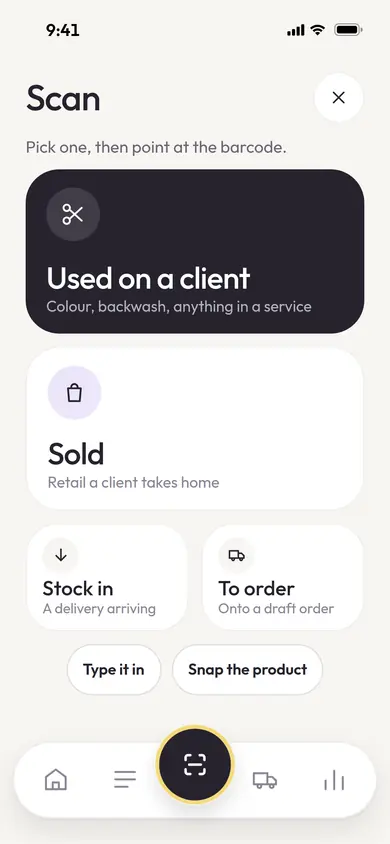
Yes, if it records how each product leaves the shelf. In Stocktend, our app for hair salons, products sit in Colours, Backwash and Retail, plus Sundries (gloves, foils, cotton wool, blades) if you want to track them, and every scan out says whether the product was used on a client or sold. That keeps backbar use and retail sales apart without a second system.
Stocktend works alongside your booking system and does not connect to your till, so a retail sale is scanned in the app as well as rung through the till. It is on the App Store and Google Play, for iPhone and Android. See how Stocktend works, or read our comparison of salon inventory apps for the alternatives. For the counting side, here is how to do a salon stocktake in under an hour.
Questions salons ask
Is colour backbar stock?
Yes. Colour, lightener, developer and toners used in services are backbar stock, even though they live at the colour bar rather than the basins. It is worth tracking colour as its own group within backbar, because it has so many shades with only one or two of each on the shelf.
What does backbar mean in a salon?
Backbar is salon shorthand for the professional products your team uses on clients during services, as opposed to retail products sold for clients to use at home. It covers the basins, the colour bar and the products used to finish a style.
How do I stop the team using retail stock at the backwash?
Keep backbar stocked to its par level, store retail away from the basins and colour bar, and agree that any retail bottle taken for a client is recorded as a move to backbar. If backbar never runs out, nobody needs to borrow.
How do I work out backbar cost per service?
Add up what a service uses at cost: the colour and developer in the bowl, plus a share of the shampoo, conditioner and treatment. Weighing systems do this bowl by bowl. A weekly backbar count set against the number of services you did gives a simpler average.
On the App Store and Google Play
Let Stocktend keep count
Stocktend is a stock app for hair salons. Snap a supplier invoice, check the lines and they land on your shelf, scan products out at the backwash or the till, and see what is running low before it runs out. It works alongside the booking system you already use.
£8.99 a month for your whole team, and every new salon gets a 2-month free trial. See pricing.