

Stock control
Salon stock control: a practical guide for UK salons
The short answer
Salon stock control, also called salon inventory management, means knowing what you have, what you use and when to reorder, across colour, backwash and retail products. In practice it is three habits: record deliveries as they arrive, record products as they are used or sold, and count the shelves regularly so your records stay true.
What is salon stock control?
Salon stock control is the routine that keeps the right products on your shelves without tying up too much money in them. It covers ordering, checking deliveries in, recording what is used at the backwash and colour bar, recording what is sold, counting what is left and reordering before anything runs out.
A stocktake is one part of it, not the whole thing: the count that checks your records against the shelf. Stock control is everything around that count, and it runs as a loop.
- Order. Order from each supplier on a fixed day, from one running low list.
- Receive. Check each delivery against its delivery note before it goes on the shelf.
- Store. Keep backbar and retail apart, with the oldest stock at the front.
- Use and sell. Record each product as it is opened at the backwash or colour bar, or sold at the till.
- Count. Count regularly, so your records stay true to the shelf.
- Reorder. Order up to each product's par level, and the loop starts again.
Why do salons run out of stock?
A salon runs out when nobody can see stock falling in time to reorder. Products are used at the backwash without being recorded, reordering depends on one person's memory, and short or wrong deliveries go on the shelf without being checked. The money was there; the warning was not.
- Backbar use is not recorded, so the shelf empties faster than anyone's list says.
- Ordering lives in one head. When that person is off, the order is late or missed.
- Deliveries are not checked against the delivery note, so a missing shade is only noticed when a client is in the chair.
- Levels were set once and never changed, even though the services you do change with the seasons.
- Retail and backbar share a shelf, so a retail bottle quietly becomes a backwash bottle.
- Opened spares hide in drawers and at stations, so the count on the main shelf looks wrong.
What stock should a salon keep track of?
Track everything you reorder, grouped by how it leaves the shelf: colour (tubes, lightener, developer and toners), backwash (shampoo, conditioner and treatments used on clients) and retail (products clients take home). Give sundries such as foils and gloves a simple count too, because running out of them stops a service just the same.
| Group | Examples | How it leaves the shelf | What to watch |
|---|---|---|---|
| Colour | Permanent and semi-permanent colour, lightener, developer, toners | Mixed for colour services | Many shades with only one or two of each, so one busy day can empty a shade |
| Backwash | Shampoo, conditioner and treatments in salon sizes | Used on clients at the basin | It goes a little at a time, so it empties without anyone noticing |
| Retail | Shampoo, conditioner and styling products in home sizes | Sold to clients at the till | Money tied up on the shelf, slow sellers, products past their best |
| Sundries | Foils, gloves, cotton wool, colour bowls and brushes | Used up in services | Cheap, but running out stops a service just the same |
Colour and backwash are both backbar: products your team uses on clients. Retail is what you sell. Keeping the two apart is one of the most useful things you can do; our guide to backbar and retail stock explains why and how.
How do salons keep track of stock day to day?
Record stock at the moment it moves. Book each delivery in against its delivery note, record each product as it is used on a client or sold, and keep one running low list that the person who orders checks on a fixed day. A short weekly check of fast movers catches anything that slipped through.
- Book deliveries in on the day they arrive. Check products, shades, sizes and quantities against the delivery note, and note anything short or wrong straight away.
- Record what goes out. Scan or tick each product when it is opened at the backwash or colour bar, and when it is sold at the till.
- Keep one running low list. Everyone adds to the same list, on paper by the dispensary or in an app, so nothing depends on memory.
- Order on a fixed day. One named person orders each week from the running low list, up to each product's par level.
- Check the fast movers weekly. Colour, developer and backwash products, the same day each week, just before you order.
How often should a salon count its stock?
Count little and often. Check fast movers such as colour, developer and backwash products every week, count everything once a month or once a quarter, and do a full stocktake at your financial year end if your accountant needs a closing stock figure. The best rhythm is the one your salon will keep.
| Check | What to count | When |
|---|---|---|
| Weekly check | Colour, developer, lightener and backwash products | The same day each week, just before you order |
| Full count | Every product, including retail and the storeroom | Once a month or once a quarter |
| Year-end stocktake | Every product, with cost prices | At your financial year end, if your accountant needs a closing stock figure |
A full count does not have to take a day. Here is how to do a salon stocktake in under an hour, shelf by shelf.
What is a par level?
A par level is the amount of a product you want on the shelf once an order arrives. Set it from what you use between deliveries, plus a small buffer for busy weeks and late deliveries. On order day you order the difference between the par level and what is on the shelf, and nothing more.
- Find your usage. How many of this product do you use between one delivery and the next? Your records, or two or three weekly counts, will tell you.
- Add a buffer. One or two extra covers a busy week or a late delivery. Use a bigger buffer for anything you cannot do a service without, such as your most used developer.
- Write it down. Usage plus buffer is the par level. Put it on the shelf label or in your app, so anyone can order.
- Order up to par. On order day, order the par level minus what is on the shelf.
For example, with round numbers: say you use about three tubes of one shade a week and you order weekly. Add a buffer of two and the par level is five. On order day there are two on the shelf, so you order three.
Look at your par levels every few months and before your busiest weeks. A shade that has not moved in months can come down; one that runs out before order day needs to go up.
Is a spreadsheet enough for salon stock control?
A spreadsheet can work as a simple salon inventory list for a small salon where one person does all the ordering and keeps it up to date weekly. It struggles once several people use stock: nobody updates it at the backwash, the counts drift from the shelf, and only the person with the file knows what is running low.
| Question | Spreadsheet | Booking system stock tools | Stocktend |
|---|---|---|---|
| Cost | Free if you already have Google Sheets or Excel | Included in some plans. See what they cost | £8.99 a month or £90 a year; every new salon gets a 2-month free trial |
| Booking deliveries in | Typed in by hand | Depends on the system: by hand, by import or by barcode | A photo or PDF of the invoice; you confirm each line |
| Recording backbar use | By hand, if someone remembers | Some systems take off professional products used in a service | A scan: "Used on a client" |
| Running low | Formulas you build and keep up to date | Low stock alerts in many systems | A running low list from one salon-wide rule |
| The whole team | One shared file that is easy to overwrite | Depends on staff logins and permissions | Everyone invited by link, with the same live count |
| Your booking system | Separate | It is your booking system | Works alongside it; no connection |
Can an app do salon stock control for you?
An app does the recording and the sums, but not the habits. It can read deliveries in, take products off as they are scanned, keep the running low list and show who used what. Someone still has to scan at the backwash and the till, count now and then, and place the order.
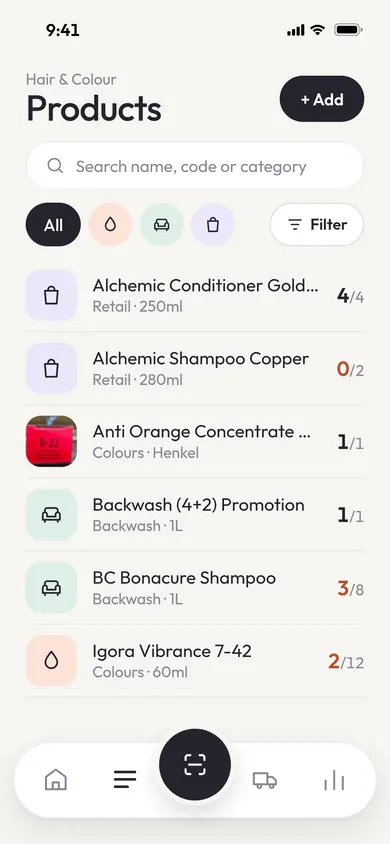
That is the job we built Stocktend, a stock app for hair salons, to do. Snap a supplier invoice, check the lines and they land on the shelf; scan products when they are used on a client or sold; and the running low list builds itself. It works alongside your booking system, on iPhone and Android. If you are weighing up options, our honest comparison of salon inventory apps covers the alternatives, including the stock tools inside booking systems.
Questions salons ask
What is the difference between stock control and a stocktake?
Stock control is the whole routine of ordering, receiving, recording use and sales, counting and reordering. A stocktake is one part of it: a full count of everything on your shelves, which checks your records against reality and gives you a value for the stock you hold.
Who should be in charge of salon stock?
One named person should own ordering, for example the salon manager or a senior stylist, with a named stand-in for holidays. Everyone else records what they use and adds to the running low list. When everyone is in charge of ordering, nobody is.
How do I stop running out of developer?
Give each strength of developer its own par level, count it at every weekly check and keep a sealed spare of the strength you use most. Developer is used across so many colour services that it is worth recording each bottle as it is opened, not when it is finished.
How much stock should a salon hold?
Enough of each product to last until your next delivery arrives, plus a small buffer. That is exactly what a par level gives you, product by product. Holding much more ties up cash and shelf space; holding less means running out between deliveries.
On the App Store and Google Play
Let Stocktend keep count
Stocktend is a stock app for hair salons. Snap a supplier invoice, check the lines and they land on your shelf, scan products out at the backwash or the till, and see what is running low before it runs out. It works alongside the booking system you already use.
£8.99 a month for your whole team, and every new salon gets a 2-month free trial. See pricing.